Let's Talk VoxPort
What VoxPort Is, and Why We Built It This Way

A look at our current product, what the new Spaces unlocks for us next. Why we think the way we've built and are currently building VoxPort, changes what a podcast host can be.

VoxPort starts from a simple premise: your show's identity should belong to you, not us. That idea shapes every part of the product, and it's why VoxPort exists. A recording studio that runs entirely in the browser, a publishing pipeline that speaks both RSS (so Apple, Spotify, and other platforms work) and ATProto (so your identity travels with you), and a discovery layer built directly into the Atmosphere instead of a private one.
What you can do on VoxPort today
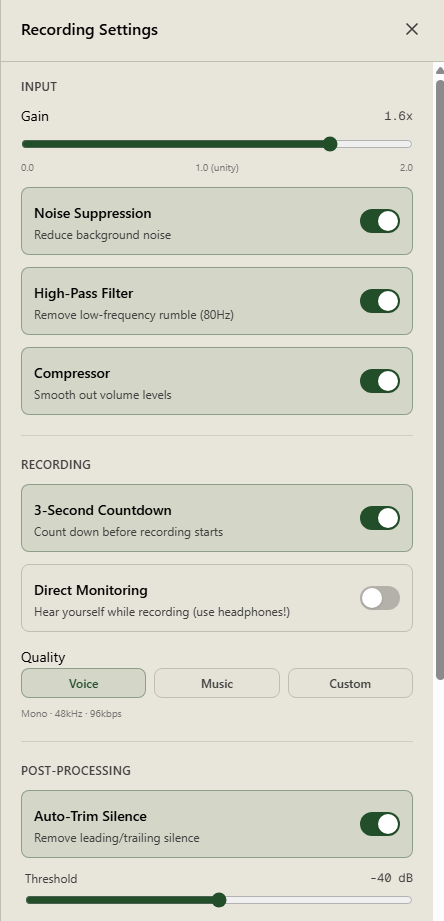
The recording booth runs in your browser, no app to install today, nothing uploaded until you're ready to publish. As you record, it runs your voice through a live processing chain, the same kinds of adjustments a sound engineer would make; happening automatically in real time!
- Gain sets your input level; it brings your mic up to a healthy level so you're not recording too quietly or too loudly.
- Compression evens out the gap between your loud and quiet moments, so you don't spike when you get excited or disappear when you trail off. It's what makes a voice sound "produced" instead of uneven.
- High-pass filtering cuts out low-end rumbling, the stuff you don't notice until it's there. Examples like AC hums, a desk bump, or footsteps in the room.
- Noise suppression (built into the browser) will reduce steady background noise, such as a fan or computer hiss.

While you record, a level meter shows how loud you are at any moment. You'll be able to see if you're too quiet or clipping (peaking so loudly that the audio begins to distort), and a scrolling waveform displays your audio as it comes in. You can literally watch yourself talk as you record.
Once you've recorded, the booth does the real work, not just trimming.
- Silence trimming removes dead air from the front and back, so your episode starts when you start talking.
- Fades ease the audio in at the start and out at the end, instead of cutting in and out abruptly.
- A noise gate automatically mutes the track in the gaps when no one's speaking, so room noise doesn't bleed through between sentences.
- Peak normalization raises your whole recording to a consistent target loudness, so this episode sounds as loud as your last one.

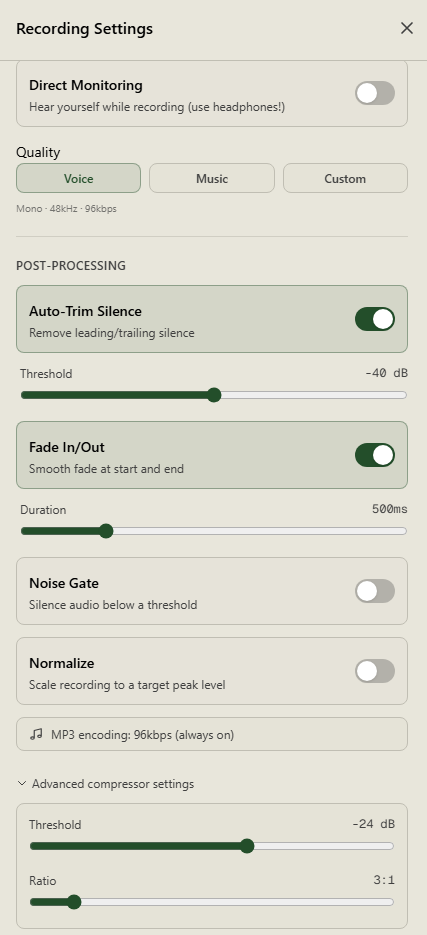
Silence trimming and fades are on by default, but can be toggled off. The noise gate and normalization are toggled off to begin; users will need to adjust them in the recording settings. You can also record multiple takes, separate attempts at the same segment, and compare them side by side before picking the keeper. You can drop the chapter markers with a keystroke as you go (the timestamps that let a listener skip to "the interview starts here"). And there's also a clip library! You can upload your intro, outro, and ad reads once, then drop them in at any point in the episode. The clips are stitched in with an equal-power crossfade, a blend at the seam that keeps the volume steady rather than dipping where the two clips meet. It makes it sound like a single continuous recording, with no re-recording required.
All of this runs on your computer, which raises a fair question. Won't heavy audio work make my browser freeze? It won't, because the demanding parts- the audio math and the final MP3 encoding (packaging your raw audio into the compressed file podcast apps actually play)- happen in a Web Worker. The Web Worker runs in a separate background thread in the browser and doesn't block the part that draws your screen. So a two-hour recording stays responsive. Your work is quietly saved locally in your browser every few seconds, so a crashed browser or a closed laptop doesn't cost you the episode; the booth picks up where you left off.
One detail that quietly matters: no matter which browser you record in, the booth encodes everything down to a single standard MP3. Chrome, Firefox, and Safari each record in their own format by default; we normalize that away so the file in your feed plays the same everywhere.
The practical upshot: producing a solid, polished episode in the booth costs us, and you, close to nothing in server compute, because your computer does the work instead of ours. That's the baseline, and it stays free: the core record-and-produce loop lives in your browser, not on a meter. We're also actively building the next wave of booth features, including heavier AI-powered enhancements that will arrive as optional upgrades for creators who want them, not as a price of showing up.
Publish once, land everywhere
When you hit publish, three things happen at once:
- Your audio lands in storage and gets a standard RSS 2.0 + iTunes-namespace feed item, so essentially every podcast app can already play it. The feed also includes Podcasting 2.0 tags like chapters, transcripts, persons, and soundbites for apps that support them.
- Your episode is written as a record on your own ATProto identity, the same protocol Bluesky runs on, and many other new platforms. It's not a copy VoxPort keeps for itself; rather, a record tied to your DID (a permanent ID you own, not ours) that's visible on the open network and portable if you ever move your identity to a different host entirely. If you've opted in, your episode is also automatically cross-posted to Bluesky (and visible to other apps on the protocol) as a post that links straight to the episode and carries a machine-readable reference back to the episode record, so your followers there see it without you doing anything extra.
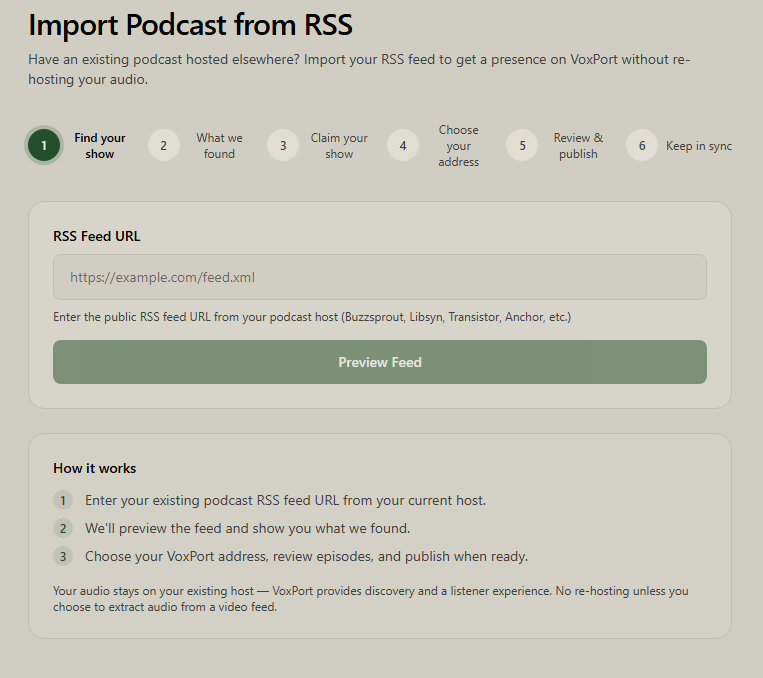
- If you're migrating an existing show, VoxPort can import your whole back catalog from another host. This includes shows that only ever published video, where a dedicated worker strips the audio track out for you automatically. Once imported, VoxPort automatically re-checks your source feed for new episodes on a regular schedule (as often as hourly), so nothing falls behind.

That combination, RSS for compatibility and ATProto for identity, is the part that's easy to undersell in a feature list and hard to overstate in practice.
Discovery that isn't a black box
Now that your show's activity lives on the same open network as Bluesky, Blacksky, and others, VoxPort can watch the live stream of public activity happening around your episodes in real time. The follows, likes, reposts, replies, and mentions are broadcast from the open network. Not a proprietary analytics dashboard you have to trust, but activity you could, in principle, verify yourself on the open protocol. That powers real discovery surfaces, trending and latest episodes pages, creator leaderboards, engagement velocity, and a picture of who's actually engaging with your show and how that engagement moves over time.
No traditional podcast host offers this, for a structural reason: they don't have a social graph to watch. We do, because we didn't build one; we're standing on top of one that already exists.
What actually separates this from the alternatives
It's worth being specific here rather than just asserting we're different, because the differences are structural, not cosmetic.
Against traditional podcast hosts: almost every host will tell you that you "own your content," and on the audio file itself, that's mostly true; you can download it and take it with you. But that's the easier part of ownership. The hard part is everything around the file: switching hosts means dealing with feed redirects and hoping your old host cooperates, and your audience relationship isn't something you own at all because in RSS podcasting, nobody does. Subscriptions are anonymous; not even your host knows who your listeners are. On VoxPort, the people who follow your show follow a DID you control, as real portable records on an open network. The relationship between you and your audience actually exists, and it's yours, not an account row in our database.
Against tools built primarily for editing: these tools are, reasonably, not in the hosting business. They're a place you produce a file and then export it somewhere else; you're expected to bring your own host to generate the RSS feed. That's a fundamentally different product from one that owns the feed, the identity, and the audience graph as a single loop. The gap also shows up in economics, especially with the cloud-based editors: because their pipeline runs on servers, you're on a meter from the first minute, billed by media hours or AI credits even for the basic work of recording and cleaning up a file. Ours runs in your browser, so our baseline tier costs you nothing, no matter how long the recording.
We're not claiming to have out-built every dedicated audio editor on the market feature-for-feature yet; there's real work ahead, and we're doing it. We are brainstorming ways to give our users an efficient, trustworthy, and professional experience. What we're claiming is narrower, and we think, more durable: the parts of this product that are hardest to copy, the feed you own, the portable identity, the live social graph, are all shipped, and they don't depend on catching up to anyone else's roadmap.
What's next: ATProto Spaces
Just a few weeks ago (late August), the team behind the protocol shipped an alpha of something called Spaces, arguably the biggest change to the protocol since it launched and one that we think matters a lot for where podcasting on the open social web goes next.
Here's the short version of what it is. ATProto has always been public by default; every record on the network- a post, a follow, a podcast episode is visible to anyone who wants to look. That's been a feature, not a limitation, but it's also meant that anything that needs to be private has had no home on the protocol at all. Spaces change that. A "space" is a small, gated slice of the same network, same identities, same data model, same portability. Except a designated authority decides who's allowed to read and write into it. It's worth being precise about what that does and doesn't mean. Spaces gives you access control, not encryption. Nothing about them is designed to hide data from a determined attacker; they're designed to let you say "only these people see this" the same way a private group chat or a subscriber-only newsletter works today. It's built on portable identity rather than a platform's internal permission system.
Make no mistake, this is early: breaking changes are expected, there's been no security review (that we're aware of), and know that the sandbox gets wiped the moment the alpha ends. We're not putting anything real on it yet. But it's stable enough conceptually to be worth thinking through, and a few uses jump out immediately for a podcast platform built the way VoxPort is:
- Portable drafts. Right now, an unpublished episode only exists in our database. If Spaces matures the way it looks like it will, a creator's drafts could live in a private space tied to their own identity, still not visible to anyone else, but no longer something that only exists because VoxPort happens to be storing it. Your work-in-progress becomes yours in the same way your published episodes already are.
- Listening state that follows you, not us. No podcast platform today, VoxPort included, yet, lets your play position and saved episodes travel with you across apps. A single-member space attached to your identity could hold that state, so any ATProto-native podcast client you authorize (ours or, eventually, someone else's) picks up exactly where you left off. That's a small thing that would be a genuinely new capability in podcasting, not just a nicer version of something that already exists elsewhere.
- Subscription shows that aren't locked to one host. This is the one we're most excited about. Paid podcasts today mean a private RSS feed with a per-subscriber token, entirely managed by whichever host you picked. If you switch hosts, you rebuild your subscriber list from scratch. A gated space changes the shape of that problem. A creator's paid tier becomes a space where subscriber access is a list of identities, not a list of tokens tied to our infrastructure. The subscription relationship becomes more of a fact about the creator's identity than a feature of ours.
None of this is shipping tomorrow. But we think it's worth saying out loud where we think this goes. It's a preview of the actual thesis: a podcast platform where leaving is possible without losing anything, because nothing that matters was ever locked to us in the first place.
Why we're writing this
We could have written this post as a list of features and nothing else since it’s our first official blog. We didn't, because we think the interesting part isn't any single feature; it's the shape of the whole thing. A recording booth that costs nothing to run because it lives in your browser. A publishing pipeline that writes to a network you don't need our permission to leave. A discovery layer built on a social graph that already existed before we did. And a protocol update on the horizon that makes the "your identity, not our database" bet even more literal.
If you believe podcasting should work this way, we'd rather you follow along and watch us build it than take our word for it. That's the whole point of building on the protocol, you can actually check.
Please reach out if you have any questions, concerns, or requests!
[email protected]
VoxPort Team 🎙️